

The future of work is…
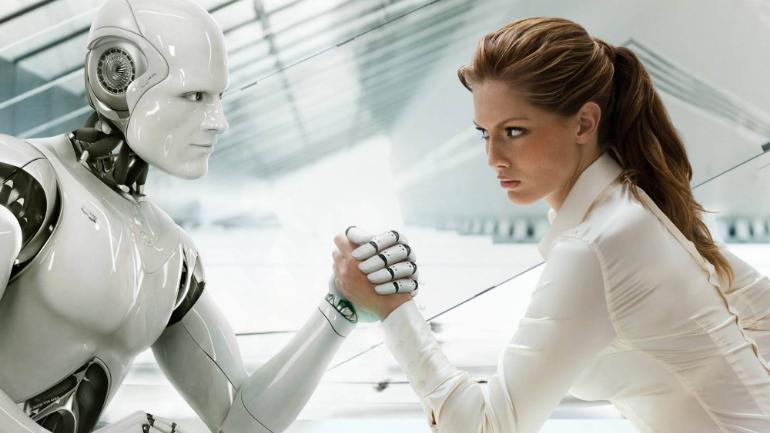
Last week we had the opportunity to exhibit at the CIPD Festival of work conference in London. It was a great experience to be able to participate at a conference of this size, and there were some unique ways in which they encouraged collaboration amongst the delegates. One of the ways was through the use of discussion walls placed throughout the exhibition hall. Each discussion wall posed a statement or asked a question and delegates were invited to share their thoughts using post it notes.
A wall we found to be of interest was directly opposite our stand, and it posed the following statement “The future of work is human, because…….”. As you can imagine there were a flurry of responses all indicating that most people are fearful when it comes to automation. The underlying mood and dominant rhetoric is still that the robots are coming and there will be little space left for humans.
We thought we would take a crack at responding. Below is our point of view, and we would love to know yours, so please share your thoughts with us in the comments section below.
“The future of work is human” and we would like to add will always be human. In our view, this is because work is defined as performing physical and mental tasks to achieve a specific purpose or result. Based on this, artificial intelligence (AI) can’t have purpose or desired results to achieve. An analogy here would be that of Clydesdale horses. Yes, they are able to perform the task of ploughing fields, but they are not able to define the parameters of the task or the desired results that need to be achieved, thus the work was done by the farmer and the horse was a mere tool used in execution of the work. Later on tractors took over from horses and further into the future robots may well perform that same task. Through this process of engineering evolution certain jobs were lost. For example, initially you needed to have handlers for the horses and later on tractor drivers. In the future you will not require either. But that doesn’t make the work less human as the farmer still needs to define the purpose and desired result in order to use the tools effectively. At the same time however, engineering evolutions also create new roles such as initially the mechanic and then later the robotic engineers.
However, the challenge that we are facing and what is giving rise to the fear is that the fourth industrial revolution means that the new roles being created and those being augmented are leaning heavily towards increased cognitive and emotive ability, leaving very little room for more rudimentary tasks. For now, it is at this rudimentary level where the biggest impact of AI and robotic solutions will be. The challenge lies not in the number of roles being automated or augmented, since the limitless nature of human ambition will creates new roles, but rather in the mismatch between future role requirements and current competencies.
This is a mismatch between demand and supply, the increase in demand for higher cognitive and emotive competencies versus the supply of rudimentary skills. The absence of competencies such as critical thinking or the ability for concept formation is particularly challenging.
Solving for this challenge requires a complete reform of educational and learning initiatives and programmes. Transformation from grassroots level up is needed to move away from mere attaining and retaining subject matter knowledge to developing advanced cognitive and emotive abilities. There is also a call to action for organisations, as education systems have not been able to adapt to the requirements posed by the fourth industrial revolution. Employees are therefore unprepared for the world of work and their baseline competencies are underdeveloped. The onus is now on the employer to bridge that learning gap. Making up for the chasm left by the education system is unrealistic in the short period of time allowed before the changes hit business. This is all the more reason why targeted, individualised approaches are needed to close the specific learning gaps identified at an individual level based on their specific role augmentations or their need to shift into new roles where they can play to their cognitive and emotive strengths.
In essence then, the statement is not “the future of work is human” as by definition it will always be. Instead the real question we should be asking is can learning and development keep pace with the progression of science and technology by becoming increasingly skilled at cognitive and emotive competencies before the robots replace us as tools in the execution of work? In our view the answer is only in some cases, what is yours?