
Go big or stay home

Insights from the latest Leesman Index research tell us that average home supports the average employee better than the average office. In this article we’ll take you through what this means for your workplace going forward.
March 2020 saw the release of the latest Leesman Index* study, entitled Workplace 2021: Appraising future-readiness which assimilates over 160 000 employee surveys carried out over the past 12 months. It’s the largest benchmark of its kind.
The study was carried out across the corporate sector, predominantly in US, Europe and Asia, and sought to better understand the work from home (WFH) experience as compared to the traditional office-based experience pre-Covid.
It’s a particularly useful study to plug into to get a broad sense of global corporates’ workplace challenges around the physical workplace (home and office), and emerging trends.
Some key insights are highlighted below.
- The WFH experience has been great for many respondents, however many others have struggled.
Key drivers of the levels of satisfaction of the home working experience have been around work activity complexity, levels of collaboration and home work settings.
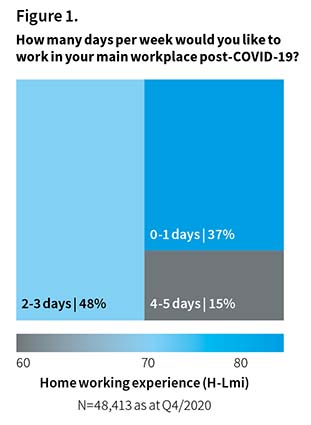
- There was a visible correlation between the quality of respondents’ home working experience and the amount of time they desired to be back in the office.
While most respondents would like to adopt a form of hybrid working going forward, those who had a less favourable WFH experience would choose to spend more time in the office going forward.
- There are advantages and disadvantages for each workplace in the hybrid mix.
In a hybrid work model, various places exist where work can be done, and each has its advantages and disadvantages. Some activities simply work better at home, and some simply better at the office.
For example, while working from home an employee may benefit from greater privacy and ability to focus, which could sometimes be difficult in the traditional office.
From the office, an employee may benefit from greater access to and connection with their colleagues, and greater awareness of other happenings in the organisation. These are not as easily achieved at home.
Adding to the possible places in the hybrid model, is what we call the third space, which could be any other space where work gets done, such as a coworking space or coffee shop.
- While it may make sense then to bring people back to the office in some form of hybrid working, it’s not going to be easy to attract them back!
Depending on your business, you’re probably going to be wanting to bring your employees back to the office in some capacity going forward.
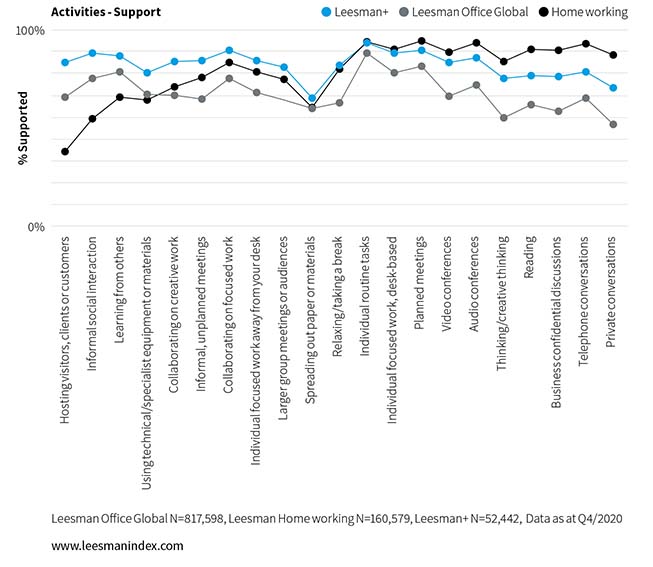
When comparing respondents’ experiences of the workplaces pre-Covid, and their home working experiences over the past year, the majority of respondents rated their home experiences as better than their pre-Covid workplace experiences.
It must be noted that this study took place over the course of 12 months. Over that time many employees have been repurposing spaces in their homes into highly effective work environments. They are in a much better position now to work from home than they were before.
Why would you want to come back to an office that doesn’t serve your needs as well as your home does?
The only group of respondents who rated their pre-Covid workplace experiences higher than their WFH experiences were those at “Leesman +” rated workplaces. These are workplaces that have received an “exceptional” Leesman rating according to the same employee survey.
These exceptional workplaces are described by Leesman as “carefully crafted ecosystems
tuned to the needs of their users” that “deliver the most consistent support across individual and collaborative work.” These are the workplaces that have outperformed their comparative home working experiences.
It’s the outstanding offices, offering an exceptional employee experience, that are going to succeed in attracting people back.
“Go big or they will stay home” Says Leesman.
What does this mean for our workplaces now?
We’ve learned so much from the past year, and will continue to discover more about the shifts in employee behaviour and expectation as time unfolds.
It’s important to recognise that the employees returning to the office are not the same people who left a year ago.
Hopefully you’ve also learned about your workplace in the last year, and gained a better understanding of its role in supporting your people and wider organisational purpose. It’s these insights unique to your organisation, that should ultimately help you to define your desired workplace outcomes and ultimately shape the creation of your new workplace experience.