

Insights into a young Entrepreneur who is cleaning up
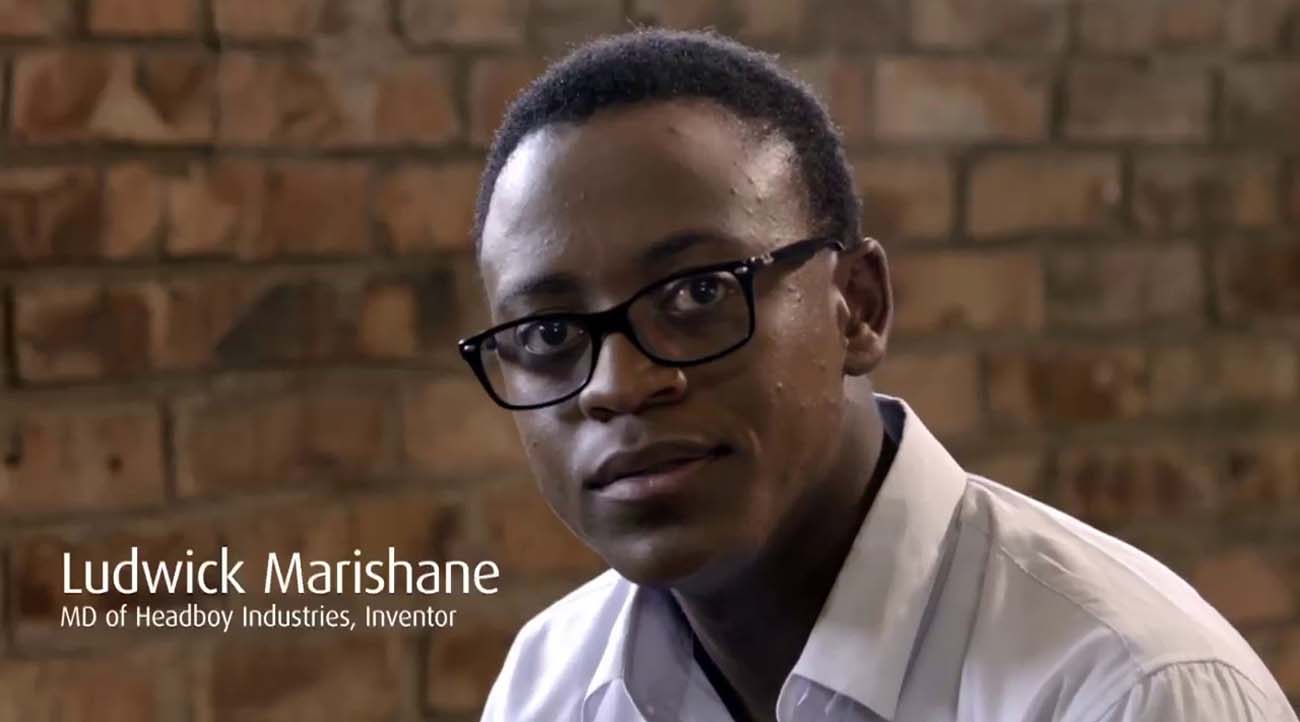
Ludwick Marishane is 29 years old and has never been formally employed in the corporate sector. Starting his entrepreneurship journey while he was still at school, Ludwick now runs a successful business employing over 20 people. Growing up and attending school in Limpopo Ludwick and some friends were shooting the breeze one day and lamenting the thought of having to bath or shower daily. This inspired the idea of inventing a product that would address personal hygiene, eliminate body odour and provide a quick way to stay clean. Using an old (non-smart) Nokia phone and time at an internet café Ludwick began to research various chemicals and cleaning agents that might achieve this goal – after much trial and error he found a formula that worked and registered a patent, (he is the youngest patent filer in the country) for DryBath® Gel – the world’s first water-less body wash. The product is currently exported to Europe, the US and Asia and with the devastating drought in the Western Cape Ludwick is hoping that Drybath will find its niche in South Africa. The journey has not always been plain sailing – in this article we will share more of Ludwick’s experiences – and what has kept him on the road.
Start-up Challenges
Being a mere 17 years-old when he patented the product and wrote his first business plan, Ludwick battled to secure funding and get Drybath off the ground. In addition to this, he was of University-going age and keen to bed down a solid education. Being accepted onto the Allan Gray Orbis Foundation’s scholarship programme and enrolling at UCT for a Business Science degree in Finance and Accounting provided both opportunities and challenges for this determined young entrepreneur. Entering business competitions to gain recognition and funding for his product became the order of the day. In the meantime, studying and reaping the benefits of all that was offered by his sponsors, Ludwick was exposed to excellent entrepreneurship opportunities by the Allan Gray Orbis Foundation – this included rigorous training in sales, negotiation skills and learning how to network. Groups of scholarship holders were required to run a retail business in their second year of study, a service business in their third year of study and a consulting business in their final year of study. World-class opportunities to learn about starting up a business but with relatively low risks involved. It was also whilst studying that Ludwick met his now-business-partner (Lungelo Gumede, now also the youngest lecturer at the UCT GSB).
Discovering new opportunities
A valuable lesson for any entrepreneur is that of spreading your risk – the age-old idea that you shouldn’t have all your eggs in one basket. Through both his scholarship programme exposure and his experience trying to hire young graduates into the business Ludwick stumbled upon a further business opportunity. Not only was it difficult to find graduates who were prepared to join a start-up business that couldn’t afford to pay corporate salaries – Ludwick also identified the high drop-out rates of university students who, for many reasons, are unable to complete their degree. Seeing this as a problem for which there must be a solution he and his partner formed a second line of business called Excel@Uni which is focused on providing student support and bursary management services.
Excel@Uni offers both software and numerous interventions aimed at improving throughput for bursary schemes. There are essentially four components of support offered:
- Private tutoring for students
- Senior-peer mentors
- Software for dynamic tracking and management of bursary schemes
- Professional development “modules” for students including public speaking, and work readiness.
Having piloted Excel@Uni with a major fund manager in the SA market, the initiative delivered the following results for the fund manager’s bursary scheme:
- A 75% turnaround in student drop outs across the scheme
- A 10% increase in the students’ academic averages across the scheme
- A 300% increase in the employability of the schemes’ graduates
Since launching, Excel@Uni has expanded to 6 more universities with triple the clients, and the number of students enrolled on their full 4-pillar support service has grown to over 50. Their initial client has been so impressed with the impact of their service that they have awarded Excel@Uni the contract to administer their full bursary fund and increased that budget by 200% to triple their number of bursars to 60 for 2019. Excel@Uni now provide top students with income through the 900 hours of tutoring bought per year, with a roster of 92 tutors for 132 university courses (with a goal to reach 41K tutors to cover all university courses in the country within 5 years).
Enabling Factors
Naturally, I was intrigued to find out from Ludwick what, in his view, the enabling factors for his success have been. Ludwick’s father worked in HR and understood the value of educating his son as well as he possibly could. In Ludwick’s words, “he abused me with books” – up until he reached Grade 4 he was encouraged to work through Curriculum 2005 workbooks, regularly reporting his progress to his Dad. The high school that Ludwick attended in Limpopo had good teachers but was poorly resourced. Due to a significant drop-out rate Ludwick ended up in a Grade 12 year where the student:teacher ratio was 15:1 – which also worked to his advantage. Hard work certainly paid off and he matriculated with no less than six distinctions.
Whilst attending University he believes he acquired valuable skills in terms of critical thinking, time management as well as access to and the ability to build a significant network. He advocates Andrew Carnegie’s philosophy1 that you should spend a third of your life learning, a third of your life making money and a third of your life giving away what you have made. Ludwick also believes in maximizing learning as cheaply as you can – by making use of mentors, advisors and having a clear vision of who you are and how you can have an impact.
His business has a frank and open culture underpinned by an experimental mindset – they are solution-focused and believe in continually experimenting until they find the right answers – and this mindset ensures that there is no such thing as failure.
Ludwick’s vision for the business is to continue to improve the human capital and talent-base for South Africans. Drybath2 can provide a viable hygiene solution for communities challenged by water and/or electricity shortages and they are currently trying to drive the production costs down to make the product more affordable. The Excel@Uni business is growing, and they will continue to look for problems that can be solved using innovative methods.
Advice for Entrepreneurs
Ludwick’s advice to other entrepreneurs is as follows: “Don’t embark on a business venture just to be your own boss – rather look for a problem that you can solve and then stay true to that. It is dangerous to get too attached to a solution as your own – work with other people to find the best solution and focus on building up from there.” He also feels that students should try to do these four things as early in their careers as possible:
- Get out of your comfort zone and explore
- Join clubs and/or societies and get yourself into a leadership position
- Get some work experience
- Spend some time outside the country to develop a global mindset.
1 Andrew Carnegie was a Scottish-American industrialist, business magnate, and philanthropist and is the third-wealthiest figure of the modern period (net worth of $310 billion).
2 Take a look at and share the “Beat DayZero Drought with DryBath Gel #DryDays Challenge” crowdfund campaign with your friends and family so that they can use one 250ml bottle of gel to replace HALF of their baths/showers each month, while getting it at a 50% discount for themselves! https://thundafund.com/project/drydays