

• About Talenttalks   |
  • FAQ   |
  • Events   |
  • Contact Us
Cart / R0.00

No products in the basket.

My account
Talenttalks
No Result
View All Result
Login
  • Culture & Engagement
  • Diversity
  • Hybrid World
  • Inspire
  • Learning & Performance
  • Magazine
  • Tools
  • Wellbeing
  • Culture & Engagement
  • Diversity
  • Hybrid World
  • Inspire
  • Learning & Performance
  • Magazine
  • Tools
  • Wellbeing
Login
Talenttalks
No Result
View All Result
Home Article

Developing learning content for different learning styles

Lita Currie by Lita Currie
May 18, 2022
in Article, Learning and Performance
0
Developing learning content for different learning styles
0
SHARES
0
VIEWS

This document describes how to create learning content to cater for the four main learning styles.

The process of learning is very similar for most people.  But we all learn in a variety of ways.  Imagine learning to play chess.  Some people like to try it out and experience it.  Others might want to read a book to understand the rules.  Others like to observe contestant playing the game and figure it out like that.

Different ways of learning are called Learning Styles and have been around for a long time.  Some recent research disputes the existence of these learning styles, but in my 20+ years’ experience as a facilitator I have found that catering your learning content to speak to these styles makes for a better learning experience and a more effective learning solution.

1. The 4 learning styles

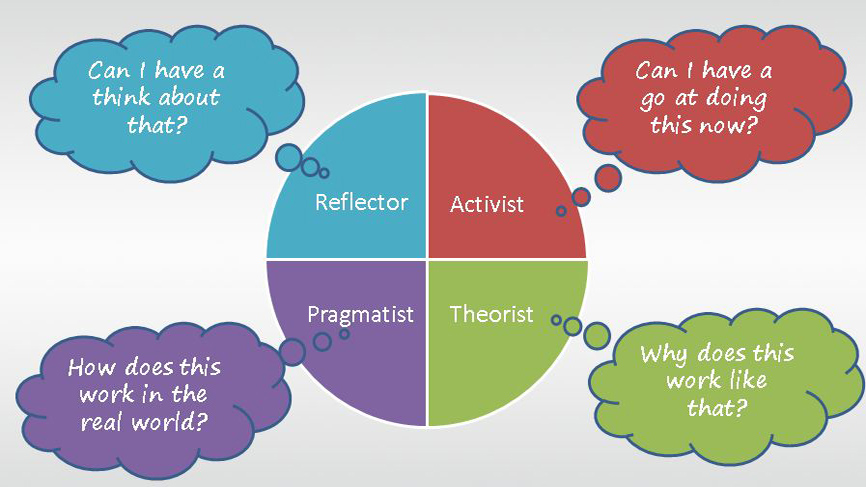
Based on the work of Peter Honey and Alan Mumford in 1983, 4 main learning styles were identified:

Activist: Like the name suggests, Activists immerse themselves in new experiences, they learn by doing (action).  They enjoy new experiences, they are open-minded, enthusiastic and flexible.  They often act first and consider the consequences later.
Reflector: These learners will stand back and observe.  They are cautious and will take a back seat during demonstrations.  They collect information, analyse it and are slower to reach conclusions because they weigh up the information.  They use learnings from their past together with immediate observations to maintain a big picture perspective.
Theorist: Theorists like to think through problems in a logical way.  They value rationality and objectivity.  They assimilate disparate facts and create coherent theories.  They are disciplined and seek to fit things into a logical order.  They are keen to know the basic assumptions, theories, models and systems.
Pragmatist: Pragmatists are focused on how to apply their learning in the real world.  They are keen to put the new learning to the test and try it out.  They like to experiment and learn from the activity.

2. Which learning style is best?

The answer is:  all of them!  Most people have a dominant learning style that they prefer, but it’s possible for any one person to learn from all the styles.  In order to design an impactful learning solutions or programme, the designer of the programme should cater for all the learning styles.

However, be careful of not giving too much airtime to your own learning style.  Because you’re comfortable in that style, the temptation to just cater for that style is strong.  Push yourself to try and apply other styles as well.

You can take a free questionnaire here to find out what your learning style preference is.

3. Using learning styles when designing learning

Here is how to choose learning activities when designing learning in order to cater for the particular styles:

Activist:
  • Business games and simulations
  • Role plays
  • Giving presentations in class
  • Working in teams and sharing ideas
Reflector:
  • Give time to think and reflect in the training
  • Observe a situation like a meeting, role play, video.
  • Conduct research and read background information and case studies
  • Exchange views with other members of a team.
Theorist:
  • Put the learning in context of a model, process or system
  • Give time to explore how elements associate and relate
  • Allow time for questioning
  • Provide complex situations with time for probing and intellectual interface.
Pragmatist:
  • Link the learning with the on-the-job application, make it real.
  • Show techniques that can be immediately applied
  • Have a chance to try out techniques with real information
  • Focus on practical issues like action plans

A good rule of thumb is to include all the learning styles when you are designing a course.  Change the activities often to ensure that the learners are engaged, and that no-one becomes bored.

Click here to download the How-to Guide in PDF

Previous Post

Pause, reflect, reframe and move forward

Next Post

Poor Performance: Training is not always the answer

Lita Currie

Lita Currie

Lita Currie has over 20 years’ experience in learning and development, with expertise in management and leadership. She has trained and consulted in Africa, the UK and north America and has been instrumental in designing and implementing global development programmes across a variety of disciplines, in particular Human Resources, Finance and Corporate Affairs. She is an expert in visual learning and performance management, using graphic facilitation to ensure that the learning is effective.

Related Posts

Conflict as a means of deepening and strengthening relationships
Article

Conflict as a means of deepening and strengthening relationships

March 13, 2023
Shifting Work Practices
Article

Shifting Work Practices

March 13, 2023
Micromanagement vs engagement. How to build team connections while respecting autonomy
Article

Micromanagement vs engagement. How to build team connections while respecting autonomy

March 13, 2023
Like magic – how to solve any problem.
Article

Like magic – how to solve any problem.

March 13, 2023
The poster boy for sustainability
Article

The poster boy for sustainability

March 13, 2023
Putting human back in people
Article

Putting human back in people

March 13, 2023
Next Post
Poor Performance:  Training is not always the answer

Poor Performance: Training is not always the answer

Topics

  • Culture and Engagement
  • Diversity
  • Employee Wellbeing
  • Events
  • Inspire
  • Learning and Performance
  • Reflection point
  • Sponsored Article
  • The Hybrid World of Work
  • Tools & Tips

Important Links

About Talenttalks

FAQ

Contact Us

Recent articles

Quick Menu

  • About
  • Culture and Engagement
  • Learning and Performance
  • The Hybrid World of Work
  • Employee Wellbeing
  • Podcasts
  • Events
  • FAQ

Newsletter Signup Form

Select list(s) to subscribe to


By submitting this form, you are consenting to receive marketing emails from: . You can revoke your consent to receive emails at any time by using the SafeUnsubscribe® link, found at the bottom of every email. Emails are serviced by Constant Contact

© Talenttalks Evolve Thinking  |   Privacy Policy   |   Terms and Conditions   |   HTML Sitemap

  • Culture & Engagement
  • Diversity
  • Hybrid World
  • Inspire
  • Learning & Performance
  • Magazine
  • Tools
  • Wellbeing

© Talenttalks Evolve Thinking  |   Privacy Policy   |   Terms and Conditions   |   HTML Sitemap

This website uses cookies. By continuing to use this website you are giving consent to cookies being used. Visit our Privacy and Cookie Policy.