
Why Psychological Safety is critical to Business Transformation

Most businesses today have strategic initiatives around business transformation, an essential part of remaining relevant in an ever-changing environment. Executives within these businesses understand and embrace the need for business transformation, and the methodologies and processes that illicit the change. Yet research shows that possibly 70% of all transformation projects fail.
Could it be, that despite implementing agile ways of work, the right methodologies and frameworks, and effective change management and communication, we have missed a most important component, i.e. our ways of thinking and being?
Psychological Safety may just be the secret sauce in successful agile transformation! Because, when individuals feel psychologically safe, they collaborate more effectively, push the boundaries of what is possible and deliver as self-organising and innovative teams.
While following process and methodology is easy, fundamentally addressing the climate and mindset within teams is not – these are the most powerful, yet most intangible aspects to manage in any transformation journey. They are specifically mentioned in the Agile Manifesto, but do we address them sufficiently to enable successful transformation?
Our processes and plans lead us to believe that we have crossed all the T’s and dotted all our I’s on the “people” aspects of transformation projects, however, until now, we have had no way to measure that we have, in fact, successfully transformed our people, without the conventional indicators provided by traditional engagement and culture surveys, which don’t measure mindset or safety (both critical enablers to successful transformation and teaming).
Simply, Psychological Safety refers to the inclusive climate that is created when our teams feel secure enough to voice their thoughts and challenge ideas without the fear of saying the wrong thing or making mistakes which could damage their credibility or reputation.
Psychological Safety enables many important outcomes, among these are the following:
- It encourages speaking up – people often refrain from speaking up because they don’t want to be seen as ignorant, incompetent, negative, or disruptive. Agile teams need to speak up confidently and safely to avoid potential risks to both the programme and organisation.
- It enables out the box thinking as individuals freely offer their ideas, without fear of being made to feel insignificant or silly.
- It supports healthy conflict – the presence of psychological safety allows teams to express their differing opinions in a way that leads to better, less biased decision-making.
- It mitigates potential business critical failures – psychological safety not only makes it safe to make acceptable mistakes but, more importantly, it makes it safe to admit mistakes and encourages learning through experimentation.
- It promotes innovation – When people feel safe to suggest novel ideas and possibilities, innovation naturally emerges.
- It creates a climate for cross-team collaboration, better enabling outcomes and project-based delivery.
- Lastly, it increases accountability: psychologically safe organisations do not fear holding people accountable, rather they encourage this through providing quality, candid feedback as a means of learning and improvement.
Measuring Psychological Safety
The Psychological Safety Scan is a diagnostic tool, based on 25 years of research and provides an indication of the Psychological Safety in teams. It maps how team members perceive the level of Psychological Safety in their closest context.
The scan comprises of 7 questions and provides an assessment at an individual and team level, measuring the 4 key imperatives of psychological safety:
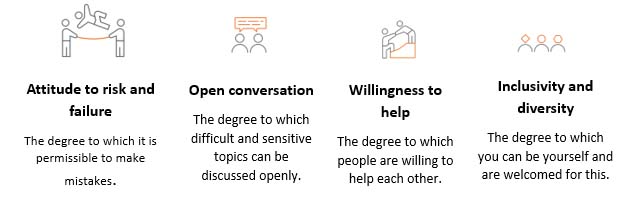
Simply through reflection on the team scores, and within a safe context, team members can identify areas of improvement within the team to increase psychological safety and thereby performance.
So, the question is, shouldn’t psychological be a critical driver of your business transformation initiatives?