• About Talenttalks   |
  • FAQ   |
  • Events   |
  • Contact Us
Cart / R0.00

No products in the basket.

My account
Talenttalks
No Result
View All Result
Login
  • Culture & Engagement
  • Diversity
  • Hybrid World
  • Inspire
  • Learning & Performance
  • Magazine
  • Tools
  • Wellbeing
  • Culture & Engagement
  • Diversity
  • Hybrid World
  • Inspire
  • Learning & Performance
  • Magazine
  • Tools
  • Wellbeing
Login
Talenttalks
No Result
View All Result
Home Article

What type of imposter are you?

Caitlin Watson by Caitlin Watson
May 18, 2022
in Article, Culture and Engagement, Learning and Performance
Reading Time: 1 min read
0
What type of imposter are you?
0
SHARES
0
VIEWS

Understanding the types of imposter syndrome and their associated triggers will help you to manage them personally and professionally.

Many high-achieving people experience what is known as ‘Imposter Syndrome’ at some point in their careers and personal lives. Imposter Syndrome can be defined as “the feeling of fraudulence experienced by successful individuals who believe that their achievements are undeserved, despite objective evidence to the contrary” (Chandra, et al.).

I’m often asked questions about how we know if someone is genuinely experiencing imposter feelings, or if they are simply experiencing moments of low self-confidence. My view is that the distinguishing factor in recognising if someone is struggling with imposter syndrome is the persistent nature of these fraudulent feelings – despite evidence that the individual is successful. I believe that understanding the types of imposter syndrome and their associated triggers will help us to manage them on a personal level; we will also be better equipped to identify the systems in our environment that contribute to imposter syndrome – and, importantly, how we can begin to change the imposter narrative in these systems.

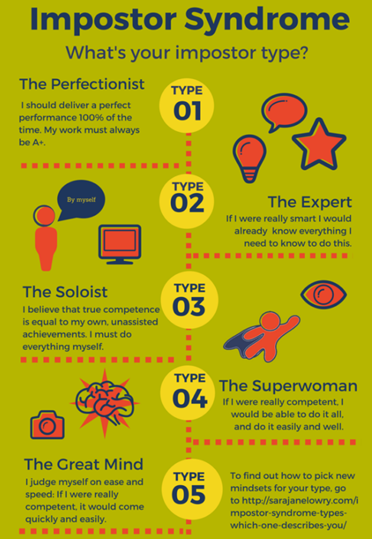
Impostor Syndrome Institute co-founder, Valerie Young, has identified 5 sub-groups of imposter syndrome:

(Image Source: Data Driven Investor)

Young explains that because people who feel like impost[e]rs hold themselves to an ‘unrealistic and unsustainable standard of competence, falling short of this standard evokes shame’. Imposters, however, don’t all experience failure-related shame the same way. And the reason is that they don’t all define competence the same way. Everyone has unconscious rules in their head about what it means to be competent. These rules tend to begin with “should,” “always,” or “never.”

For example, people experiencing imposter feelings would create the following rules: “If I were really intelligent, capable, competent, I…

… would never be confused

… would always understand what I’m reading

… should get it right the first time


How do I know which imposter type applies to me or someone I know? 

  1. The Perfectionist

The Perfectionist’s primary focus is on how something is done. This includes how the work is conducted and how it turns out. Young highlights that for the Perfectionist, “one minor flaw in an otherwise stellar performance or 99 out of 100 equals failure and thus shame.” The quality of work they deliver should be to the highest possible standard; therefore, the Perfectionist does not trust anybody else to deliver the work – if they do, they tend to micromanage people.

Perfectionists can also struggle with high levels of anxiety and struggle to get started with tasks because they fear that the execution and result will not be perfect. When they do get onto the task, they are disappointed to find that no task runs 100% perfectly, and they use the failure to achieve the one point out of 100 as evidence that they are in fact not competent. 

  1. The Expert

The Expert is primarily concerned with what they know and how much they know. Any gap in their knowledge leads them to believe that they are not competent. 

  1. The Soloist

The Soloist’s worst nightmare is to admit that they may need help with a task.  For a soloist to feel that they are competent, tasks should be completed by them, and them alone. For them, asking for help or delegating work equates to failure, and ultimately shame.

Yes, Soloists will likely complete all the tasks on their own because they are hardwired to not fail – but at what cost?  They end up doing little of what they’re good at and what makes them feel valued because they’ve volunteered to take on everybody else’s work, in the hope that the people in their environments will confirm that the Soloist is indeed competent.

Writer, Melany J. Wilding, suggests that “imposter workaholics are actually addicted to the validation that comes from working, not to the work itself.”


  1. The Superwoman/Superman/Super Student

The Superwoman/Superman/Super Student measures competence based on how many roles they can both juggle and excel in’.

If they are unable to deliver something in any one of their roles (e.g., as a partner, parent, employee, friend, family member, host/hostess, etc.), they feel ashamed because they have failed to live up to the unrealistic expectation that they should handle all the roles with ease.

The Superwoman/Superman/Super Student pressurises themselves to work harder than everybody else, because they think that they don’t quite measure up to their more competent colleagues.


  1. The Natural Genius / The Great Mind

Natural Genius Imposters base their perception of competence on the speed and ease with which they achieve their tasks.  If they take longer than what they usually deem acceptable to complete a new task (the timing of which is, let’s face it, unrealistic to begin with), they feel ashamed.


Now that we are aware of what imposter types are out there, how do we start to manage the triggers associated with some of these types?

The Expert

  • Even the most experienced expert will need to learn new things because of the pace at which our work environment is evolving and the rate at which new information is being shared.
  • All roles require some upskilling – if yours doesn’t, then you may want to think about the sustainability of the organisation for which you’re working. Any organisation that does not believe their employees require growth at all levels will struggle to keep up.

The Soloist

The African proverb ‘If you want to go fast, go alone. If you want to go far, go together’ comes to mind…

  • Changing the self-limiting ‘rule’ around delegation in the Soloist Imposter’s mind – from one of failure to one of collective success – will help them free up their capacity to do the work that really makes them stand out and allows others to do the work that makes them feel good too.

The Perfectionist

  • Regularly asking for balanced feedback on what you have done well and areas for improvement will give you a more realistic view of your actual achievements – specific metrics should accompany the feedback, so that you avoid brushing off the feedback as ‘they were just being nice’.
  • There are many feedback models available to help guide the sort of feedback you are looking for. You will be pleasantly surprised at how many people see the value of the work that you deliver – and feedback will help remind you that perfection is not necessary to achieve excellent results. You can use the SBI (Situation, Behaviour, and Impact Model) to identify specific situations where you have delivered great work. I’m a firm believer in American Journalist, Steven Levy’s, statement: ‘You can’t argue with the facts…’
  • Look at reframing how you define the successful completion of a task. Spend time genuinely understanding your unique strengths, so that when feedback is shared, it is not discounted.

Overall, how do I feel like less of an imposter?

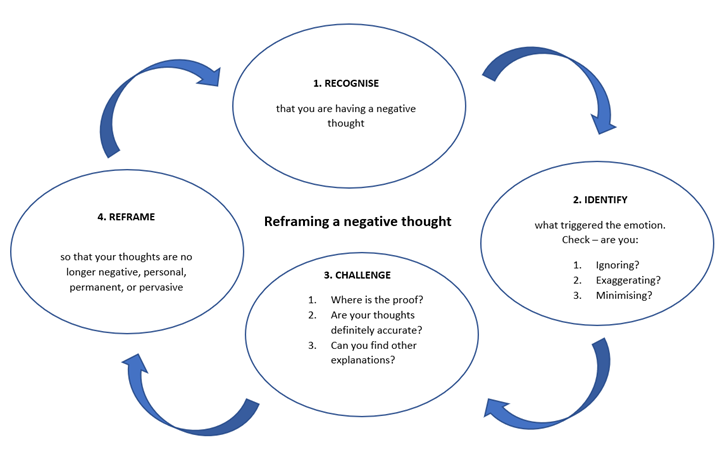
As Young points out: you may want to feel like less of an imposter, but you will not stop feeling like an imposter until you start thinking differently. My view is that to create sustainable change in this area, we should consistently reframe our thoughts – it is something that should be practiced daily. Here are some tips on how to reframe negative thoughts:

Regardless of which imposter type you identify with, you have the power to define your own narrative – and by doing so, we create the space for others to do the same.

Other episodes and articles

  • During my research, I learned that many, many people experience imposter feelings at work – in fact, as Collins points out, up to 70% of people (and many of these include CEOs, Oscar-winning actors and Pulitzer Prize winners).

  • Other episodes and articles During my research, I learned that many, many people experience imposter feelings at work – in fact, as Collins points out, up to 70% of people (and many of these include CEOs, Oscar-winning actors and Pulitzer Prize winners).
Previous Post

The predictably unpredictable future

Next Post

Bio Hacking Episode 2

Caitlin Watson

Caitlin Watson

Caitlin Watson is an experienced talent management consultant and has been involved in defining, implementing, facilitating and measuring the learning and development, skills development, talent management, and performance management journeys for customers across the value chain in the FMCG, Telecommunications and Private Education industries.

Related Posts

Conflict as a means of deepening and strengthening relationships
Article

Conflict as a means of deepening and strengthening relationships

March 13, 2023
Shifting Work Practices
Article

Shifting Work Practices

March 13, 2023
Micromanagement vs engagement. How to build team connections while respecting autonomy
Article

Micromanagement vs engagement. How to build team connections while respecting autonomy

March 13, 2023
Like magic – how to solve any problem.
Article

Like magic – how to solve any problem.

March 13, 2023
The poster boy for sustainability
Article

The poster boy for sustainability

March 13, 2023
Putting human back in people
Article

Putting human back in people

March 13, 2023
Next Post
Discussing disconnected syndrome Podcast

Bio Hacking Episode 2

Topics

  • Culture and Engagement
  • Diversity
  • Employee Wellbeing
  • Events
  • Inspire
  • Learning and Performance
  • Reflection point
  • Sponsored Article
  • The Hybrid World of Work
  • Tools & Tips

Important Links

About Talenttalks

FAQ

Contact Us

Recent articles

Quick Menu

  • About
  • Culture and Engagement
  • Learning and Performance
  • The Hybrid World of Work
  • Employee Wellbeing
  • Podcasts
  • Events
  • FAQ

Newsletter Signup Form

Select list(s) to subscribe to

© Talenttalks Evolve Thinking  |   Privacy Policy   |   Terms and Conditions   |   HTML Sitemap

  • Culture & Engagement
  • Diversity
  • Hybrid World
  • Inspire
  • Learning & Performance
  • Magazine
  • Tools
  • Wellbeing

© Talenttalks Evolve Thinking  |   Privacy Policy   |   Terms and Conditions   |   HTML Sitemap

This website uses cookies. By continuing to use this website you are giving consent to cookies being used. Visit our Privacy and Cookie Policy.