



How good are you at learning? What have you learned about how you interacted with others this week? How do you assess your progress or impact as a leader? And have you ever reflected on these questions?
Leadership is relational. It is not enough to know what the qualities or theories of good leadership are. And becoming a good leader does not happen overnight after attending a leadership development programme or after reading every recommended leadership book. Leadership development is about undergoing profound learning about self (self-awareness) and critically evaluating how you respond to situations (social awareness). Our professional environments are complex, messy, unpredictable, and constantly changing. We need to be highly attuned to what is emerging and how to respond. The conditions call for probing, sensing, and responding.
This is where a reflective practice comes in. It helps bridge that knowledge-application gap by developing the critical thinking and action learning skills that leadership demands. Fundamentally, reflective practice is “the process of learning through and from experience towards gaining new insights of self and/or practice” (Finlay, 2008). It is a specialised form of thinking to purposefully inquire into our experiences, plan appropriate action, and test our ideas. Kolb’s Experiential Learning Theory (figure below) takes us through the typical elements and flow of reflection. Thinking, in reality, may not be as ordered or sequential as the model suggests. Still, the model gives us accessible points to engage with our experiences and plot paths towards specific learnings.
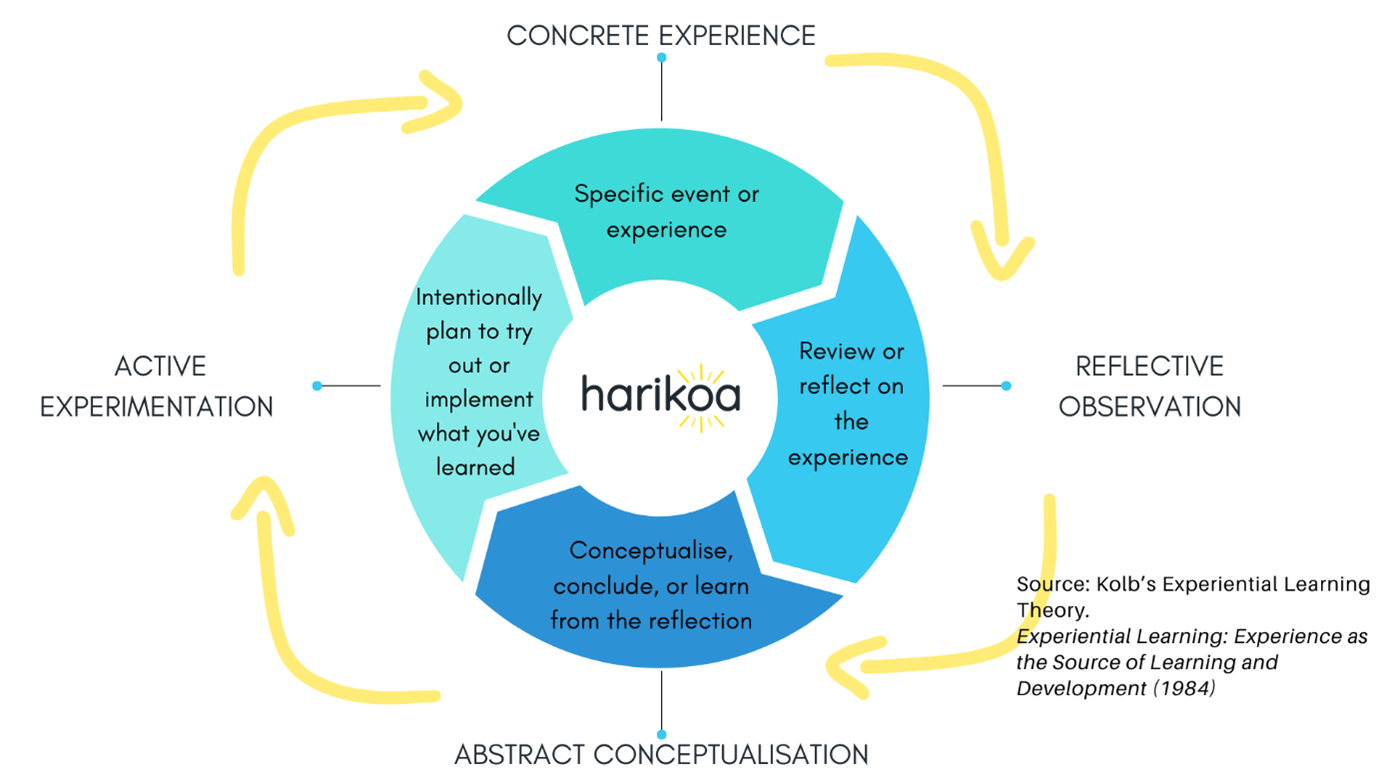
In simplistic terms,
- you are describing an experience or event (what happened),
- thinking through what makes this significant, meaningful, useful, valuable, or relevant (so what?), and
- deciding or planning what to do with that information (now what?).
This is another excellent framework for reflection and to keep on mission for team meetings, project updates, and personal development.
To kickstart your reflective practice to boost your leadership skills, here are some points to consider:
When reflecting, expand your field of view by giving attention to the leadership ‘mindtraps’. There are specific ‘mindtraps’ that we are all susceptible to but could have further-reaching consequences in leadership. These mindtraps are “part cognitive bias, part neurological quirk, part adaptive response to a simple world that doesn’t exist anymore” (Berger, 2019). The predominant mintraps or unhelpful thinking patterns that get in the way of effective decision-making, critical evaluation, and sound judgement are:
- Oversimplification: where the desire for a simple story, blinds you from the real story.
- Rightness: the need for certainty and being led by what ‘feels’ right vs what ‘is’ right.
- Agreement: the desire to connect and belong narrows the space for innovation and diverse thinking.
- Control: the desire to be in charge creates the illusion that you can control everything and discourages inclusion and safety.
- Ego: over-committed to who you are now, stops you from being open to who you can be next and limits opportunities for growth.
Look for where you have been falling into these traps and look for opportunities to initiate small actions or experiments to get you off those automatic modes.
Keep an open mind and heart. The event or experience is in the past. You are unable to change what has happened. It can be painful to reflect on situations where you may not have shown up at your best or when someone has hurt you. However, in the moments of reflection, you choose what to focus on and what learning and conclusion to draw, a la the Poetic principle found in Appreciative Inquiry: we can choose what we study. Take up a reflective practice with a compassionate, curious, learner mindset. Be open to what the reflection may reveal to you, and look for those nuggets hidden from you in the moment of the experience. Remain connected to the purpose of the reflective practice.
- To elevate reflection to a practice and not just a casual conversation at the end of the week, build it into your workweek. Set time aside to reflect on how you are showing up as a leader and your leadership development areas. This may take the form of journaling or coaching.
- If you’re new to reflective practice and journaling, you might want to try the guided journaling approach. There are many journals out there that offer prompts to focus your reflective practice and guide you towards your purpose. The Presencing Institute is a great place to start on your own, offering prompts and a process to start your reflective practice.
- For an introduction to reflective writing, and to learn more about the relevance of writing to leadership,
- To learn more about critical thinking
- To find out more about reflective practice, see Finlay’s 2008 paper on or see NASA’s reflective practice handout:
- To learn more about the ‘mindtraps’, read Jennifer Garvey Berger’s excellent short book, Unlocking Leadership Mindtraps. How to thrive in complexity
- To join a Guided Reflective Journaling Practice circle with other leaders, email sohini@harikoa.co.uk for further details. Or click on the events tab on the LifeOnline homepage.
Here is a taster set of questions offered at the Guided Reflective Journal Practice Circle mentioned above. The guidance for answering these questions is to find a quiet spot, set aside about 30 minutes of uninterrupted time, and write freely for about 3-4 per question:
- Where in your body do you feel your energy most vivid this moment?
- When did you feel energised this week?
- What drained or depleted your energy this week?
- When did you change the energy/mood of a situation this week?
- What strengths/personal resources could help you meet the challenges that next week brings?
Take a few moments to digest, observe your emotions and thoughts as you take in what you have just written.
“Maybe reflective practices offer us a way of trying to make sense of the uncertainty in our workplaces and the courage to work competently and ethically at the edge of order and chaos…”
Tony Ghaye, Into the reflective mode: bridging the stagnant moat. Reflective Practice