

The best ideas come from random encounters
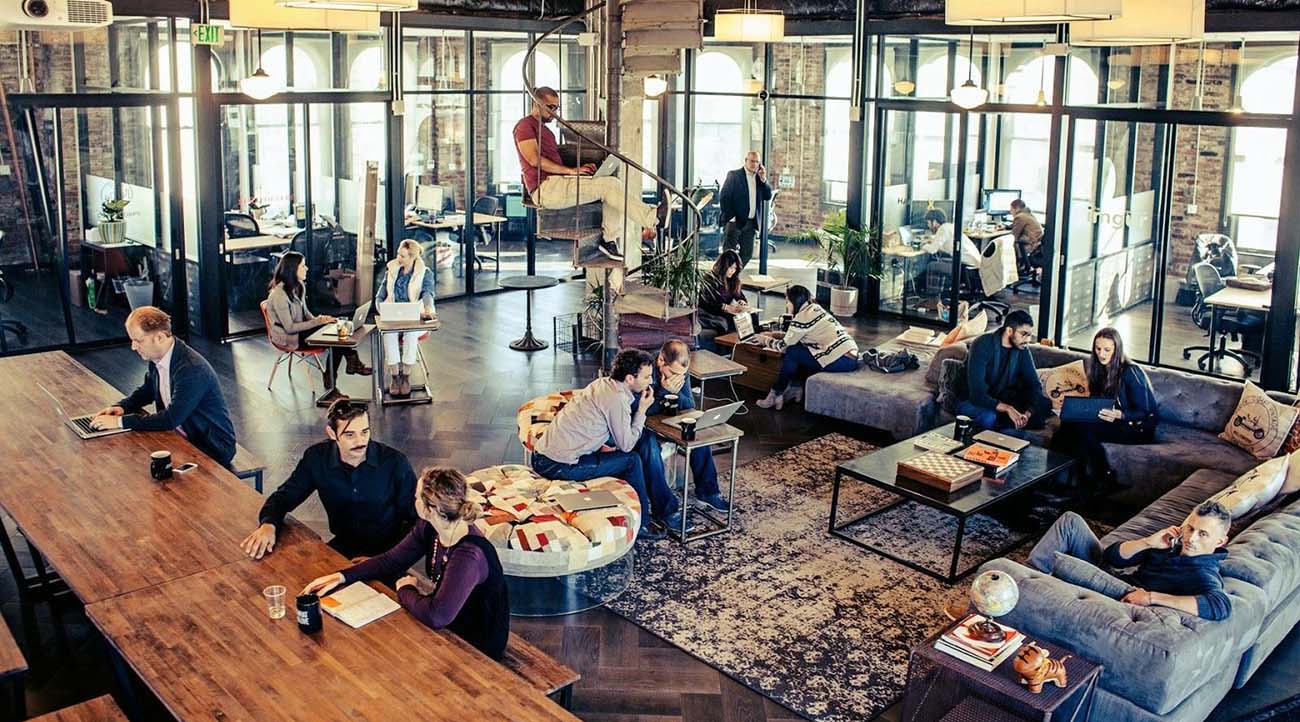
In an increasingly demanding world, where knowledge sharing is critical to performance improvement and business success, a collaborative workspace is becoming the new norm. If you’re working in a silo environment, you’re probably not interacting much and you’re keeping all your promising ideas to yourself. You need to move, mingle, brainstorm to innovate.
An important part of the modern office is the inclusion of several multi-purpose touch-down spaces that boost chance conversations that lead to solutions. It’s about redefining boundaries and creating mini-intersections wherever you go. Harvard Business Review’s report on Workspaces that Move People describes the new thoughtful workspace as one “designed to spark not just collaboration but that innovation you see when people collide.” The influence is so productive that the CEO of US clothing company Zappos has even coined the term ‘collisionable hours’, referring to a metric that measures a space’s effectiveness in terms of the probable interactions per hour per square metre.
It’s taking the old school water cooler chat to the next level, and it’s having a significant impact on office design. Staircases, for instance, are no longer strictly back office. They’re taking centre stage for the opportunities they provide for those chance encounters as people to and fro from their (hot) desks. We’re including alcoves with soft seating in stairwells to promote that quick brainstorm. Then we’re combining those support spaces where people naturally congregate to encourage increased interaction; so the water station and the printer could be in the same location complete with an appropriate huddle space.
A traditional area for informal discussion has always been the office canteen but this space is also undergoing changes in the name of collaboration. Smaller, round tables are giving way to long family-style tables where an intern could find herself grabbing a bite with the CEO. Central barista-style coffee areas are also excellent spaces for spontaneous conversation. The lighter, less inhibited environment is conducive to useful discussion with employees from a range of disciplines, divisions and ages gathering together over a meal or a cappuccino. In the same vein, in larger organisations with thousands of staff, there is a trend for micro kitchens on every floor.
Another concept being turned on its head, is that meeting places don’t necessarily need to have a formal seated space. The bar counter is highly conducive for a quick chat. The less formal atmosphere is also less intimidating than a stiff boardroom and can prompt ideas from individuals who perhaps would have normally stayed quiet. We are pairing standing room booths with white board walls, perfect for impromptu interaction. Mini meeting spaces directly outside formal conference rooms is another trend on the rise. The principle supports the view that not everybody feels comfortable to share their views in a conventional forum and some people prefer a quiet chat on the side. The spaces also promote pre-meeting discussion and post-debriefs.
Connectivity is essential for these crash spaces to be effective. Furniture manufacturers are cottoning on to this and are now incorporating power supply into their designs – a plug point on the side of a sofa or a USB port on the edge of a boardroom table.
It’s certainly an exciting time to be in office design. Work is less about the where and more about the how. Agile workers don’t just come to the office because that’s where their stuff is, they are more motivated by the opportunity to share ideas, to grow and connect with others. To be in the business of creating the spaces that prompt the constant, unplanned interactions necessary for success is both inspiring and relevant.
About Tétris
Tétris is the wholly-owned full service design, fit-out and refurbishment specialist of JLL. As a fully integrated JLL business, it is one of the only global interiors firms in South Africa. This network with an international real estate company offers credibility when pitching for blue chip business and supports a comprehensive service solution, far broader than an average fit-out contract. Based in Johannesburg, the South African Tétris team provides turnkey services to office, retail, industrial and hotel occupiers. The range of solutions covers all phases of a project: workplace strategy, conceptual and technical interior design, project management, procurement, and construction.
The South African team consists of 32 dynamic and talented design, project management and space planning experts who have all worked on high profile projects. In South Africa, key clients include leading global and local brands across a range of sectors. Recently, Tétris has completed fit-out projects for: Tech – Nokia, Tyme; Legal – DLA Piper, Herbert Smith Freehills, Baker & Mckenzie; Financial – Hannover Re; FMCG – Mondelez, Kellogg’s; Medical/Pharmaceutical – Allergan, Ascendis, Stryker; to mention just a few. Internationally, since its creation in 2003, the company has taken root in 16 countries on three continents, with a turnover reaching €387 in 2015. With 530 collaborators in 29 branches, Tétris is mobilised to meet client needs across the globe.