• About Talenttalks   |
  • FAQ   |
  • Events   |
  • Contact Us
Cart / R0.00

No products in the basket.

My account
Talenttalks
No Result
View All Result
Login
  • Culture & Engagement
  • Diversity
  • Hybrid World
  • Inspire
  • Learning & Performance
  • Magazine
  • Tools
  • Wellbeing
  • Culture & Engagement
  • Diversity
  • Hybrid World
  • Inspire
  • Learning & Performance
  • Magazine
  • Tools
  • Wellbeing
Login
Talenttalks
No Result
View All Result
Home Article

How to take charge of your emotional and mental wellbeing

Martin Probst by Martin Probst
July 21, 2021
in Article
0
How to take charge of your emotional and mental wellbeing
0
SHARES
0
VIEWS

Achieve emotional self-mastery to succeed with fulfilment and positively influence self and others.  

Now, more than ever, we are in desperate need of sound Emotional Intelligence to get us safely through challenging times, constant adaption and an ever-changing environment. While nobody questions that natural IQ and technical skills are crucially important for the success of individuals and organisations, Emotional Intelligence (EI) may be the single most important leadership trait determining work and managerial performance. As Daniel Goleman, possibly the most well-known EI theorist, puts it: “Effective leaders are alike in one crucial way: they all have a high degree of emotional intelligence”.  

Some statistics by Dr. Travis Bradberry confirm the benefits of Emotional Intelligence or Emotional Quotient:  

  • EI/EQ is responsible for 58% of your job performance 
  • 90% of top performers have high EI/EQ 
  • People with high EI/EQ make $29,000 more annually than their low EI/EQ counterparts

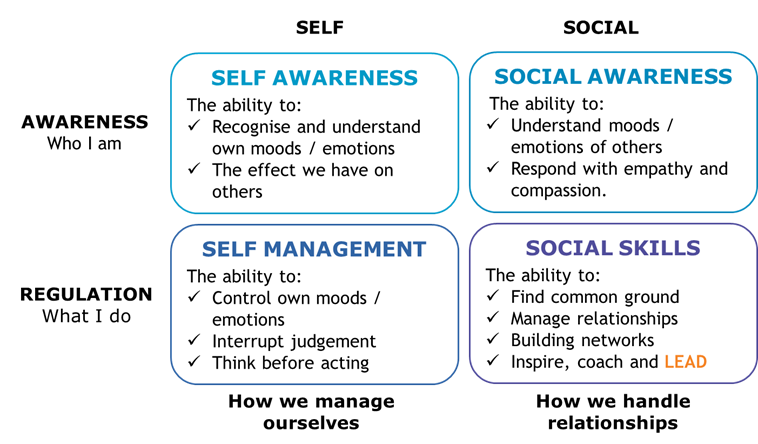
Based on the work by Daniel Goleman, following are four key components of EI as applied to highly emotionally intelligent leaders.  

  • Individuals with self awareness show self-confidence, have a realistic sense of their abilities and, interestingly, can laugh at themselves.
  • Individuals who are can master self management are trustworthy and reliable, are comfortable with grey areas and ambiguity and are open to change. Such individuals are able to take a step back, suspend judgement and reflect before acting.
  • Managers with social awareness and empathy develop and retain talented team members, use cultural understanding of emotional displays and are able to focus on customer needs.
  • Leaders with social skills are effective in gaining buy-in for change initiatives and can effectively build teams.

Our feelings are not there to be cast out or conquered.
They’re there to be engaged and expressed with imagination and intelligence.
~ T.K. Coleman

So, how can we achieve emotional self-mastery to succeed with fulfilment and positively influence ourselves and others?

Understand how the mind works

The first step leading to and developing our EI lies in understanding how our mind works. We must appreciate what makes us tick to make sure we can create self-awareness and therefore achieve emotional self-mastery. Too often, we are taught what to think rather than how to think which results in most people only producing about half of what they are actually capable of and failing when it comes to getting what they really want.

Understanding our thoughts, emotions and behaviours empowers us in our dealings with others. Successful people are aware of their thought processes, in comparison to their unsuccessful counterparts who consistently fall victim to their own negative thoughts.

Manage self-talk

Next up is to manage self-talk effectively. Words have an incredible impact and immense power. They have the power to crush us, to make us feel exhilarated, or to encourage us. Language provokes wars, is a source of controversy, creates diplomacy, fosters love, hate, confusion, and possibilities.

It has been said that language is the most powerful tool in human communication, and its effect depends entirely on how we use it. Sadly, only a minority of people know how to communicate effectively. Because we often use words automatically and unconsciously, we have learned to treat them lightly and without much thought. If we want to take control of our thoughts and manage our internal conversation successfully, we must decide which voice we choose to listen to. We can decide to give in to our fears and doubts, or we can listen to our inner voice of courage and trust.

If thought corrupts language, language can also corrupt thought.
~ George Orwell

 Read emotional cues

Another piece in the puzzle and is our ability to read others and assess emotional cues. To do this, we must develop sensory acuity to both verbal and non-verbal communication. To develop our compassion and social skills, we also need to be attuned to the potential pitfalls of miscommunication.  While verbal communication (spoken words) and vocal communication (tone, timber, tempo & volume) can provide cues on the emotions people are feeling, body language is the most powerful way to pick up emotional cues and includes for example:

  • Body movements or posture
  • Eye contact
  • Facial expressions
  • Physiological changes, such as starting to sweat or tearing up
  • Proxemics, for example how close or far away a person stands from you

Recognise emotional triggers

And last but not least, our path to emotional and mental self-mastery includes the ability to successfully deal with our emotional triggers. Emotional triggers may include stress levels, work circumstances or the behaviour of others. Everyone has their own triggers. Consider the following examples of emotional triggers:

  • People closing office doors may trigger a sense of personal exclusion.
  • People not cleaning their desk may trigger a judgement about their commitment to work and an automatic feeling of disapproval.
  • People breaking one of your personal, unwritten and unreflectively accepted rules, such as not shaking hands or not smiling when meeting or being given a task.
  • People breaking what is, for you, a core value; for example, attention to detail, professionalism or punctuality.

As Anthony Robbins explains in his book “Awaken the giant within”, whenever we feel a painful emotion, there are six steps we can take very quickly to break limiting patterns, find the benefit of that emotion, and set ourselves up so that in the future we can get the lesson from the emotion and eliminate the pain more quickly.


  1. Identify what you are really feeling
  2. Acknowledge and appreciate your emotions, knowing they support you
  3. Get curious about the message this emotion is offering you
  4. Get confident
  5. Get certain you can handle this, not only today but in the future as well
  6. Get excited and take action

Right now, during these testing times, people look for others to empower them. We need to show extraordinary action and connect and communicate exceptionally well within ourselves and with the people around us, so we can all feel positive and confident.

Until you make the unconscious conscious,
it will direct your life and you will call it fate.
~ C.G. Jung

We have a choice; it is entirely up to us to let negativity and aversion allow to bring us down, or to confidently steer our ship through rough seas by looking at the horizon with courage, strength, hope and positivity. Emotional and mental wellbeing is in our hands.

“Dare to make a difference!”

Previous Post

Finding focus in chaos

Next Post

Your strategy as a picture

Martin Probst

Martin Probst

Learning Professional of the Year | #1 International Bestselling Author | Facilitator, Trainer, Speaker, Mentor & Coach Melbourne, Victoria, Australia My endeavour to make a lasting impact on managers and work teams has brought me to spending well over 20 years travelling the world, studying the field of self-development and human potential. I understand what it means to work in pressured environments and the importance to become the best at what you do. I was awarded LEARNING PROFESSIONAL OF THE YEAR at the 2019 Australian Learning Impact Awards and I am Master Certified in numerous personal transformation modalities, have assisted countless members of middle and upper management to achieve BETTER OUTCOMES through GREATER CONFIDENCE and SMARTER CHOICES. Today, I am directly impacting the lives of many managers in Australia and around the globe through my leadership development books, online training, public speaking events, in-house workshops, and one-on-one coaching. I created our very own PROfound methodology to assist our clients achieve ultimate success through a platform of self-awareness, building effective human dynamics, as well as strong and healthy work relationships that go beyond the nine-to-five demands of the job. Our clients can’t believe how simple and easy these strategies are to learn and apply, and what immediate and profound impact they have on their professional and personal lives.

Related Posts

Conflict as a means of deepening and strengthening relationships
Article

Conflict as a means of deepening and strengthening relationships

March 13, 2023
Shifting Work Practices
Article

Shifting Work Practices

March 13, 2023
Micromanagement vs engagement. How to build team connections while respecting autonomy
Article

Micromanagement vs engagement. How to build team connections while respecting autonomy

March 13, 2023
Like magic – how to solve any problem.
Article

Like magic – how to solve any problem.

March 13, 2023
The poster boy for sustainability
Article

The poster boy for sustainability

March 13, 2023
Putting human back in people
Article

Putting human back in people

March 13, 2023
Next Post
Your strategy as a picture

Your strategy as a picture

Topics

  • Culture and Engagement
  • Diversity
  • Employee Wellbeing
  • Events
  • Inspire
  • Learning and Performance
  • Reflection point
  • Sponsored Article
  • The Hybrid World of Work
  • Tools & Tips

Important Links

About Talenttalks

FAQ

Contact Us

Recent articles

Quick Menu

  • About
  • Culture and Engagement
  • Learning and Performance
  • The Hybrid World of Work
  • Employee Wellbeing
  • Podcasts
  • Events
  • FAQ

Newsletter Signup Form

Select list(s) to subscribe to


By submitting this form, you are consenting to receive marketing emails from: . You can revoke your consent to receive emails at any time by using the SafeUnsubscribe® link, found at the bottom of every email. Emails are serviced by Constant Contact

© Talenttalks Evolve Thinking  |   Privacy Policy   |   Terms and Conditions   |   HTML Sitemap

  • Culture & Engagement
  • Diversity
  • Hybrid World
  • Inspire
  • Learning & Performance
  • Magazine
  • Tools
  • Wellbeing

© Talenttalks Evolve Thinking  |   Privacy Policy   |   Terms and Conditions   |   HTML Sitemap

This website uses cookies. By continuing to use this website you are giving consent to cookies being used. Visit our Privacy and Cookie Policy.