

• About Talenttalks   |
  • FAQ   |
  • Events   |
  • Contact Us
Cart / R0.00

No products in the basket.

My account
Talenttalks
No Result
View All Result
Login
  • Culture & Engagement
  • Diversity
  • Hybrid World
  • Inspire
  • Learning & Performance
  • Magazine
  • Tools
  • Wellbeing
  • Culture & Engagement
  • Diversity
  • Hybrid World
  • Inspire
  • Learning & Performance
  • Magazine
  • Tools
  • Wellbeing
Login
Talenttalks
No Result
View All Result
Home Culture and Engagement

How to make conflict a positive element in your team

Lita Currie by Lita Currie
May 18, 2022
in Culture and Engagement, Learning and Performance
Reading Time: 1 min read
0
How to make conflict a positive element in your team
0
SHARES
0
VIEWS

How to make conflict a positive element in your team

Conflict. Just the word has the power to conjure up strong emotions. What always fascinates me is how different people’s perceptions of conflict are. There’s an exercise in my workshops where I invite people to associate words with conflict. “Anxious”, “awkward”, “upset” and “hurt” are words that inevitably come up. But sometimes words like “progress”, “confident” and “relieved” also make an entrance. Team members who have an overwhelmingly negative view of conflict are usually gobsmacked at this. “How can conflict be positive?!” they ask.

It turns out that whether conflict is positive or negative, it pretty much depends on the lens that you look through. Conflict at work (and at home, for that matter) is pretty much a given. People have different priorities, agendas and needs. When we are in competition with others on our team for resources, status or achievements, conflict invariably shows up. How the team views conflict sets the direction for whether they use it as a positive influence or whether they allow it to derail the team. And, not surprisingly, this direction is set by the team leader.

Research shows that conflict can either be healthy or toxic, and at the same time be overt or covert.
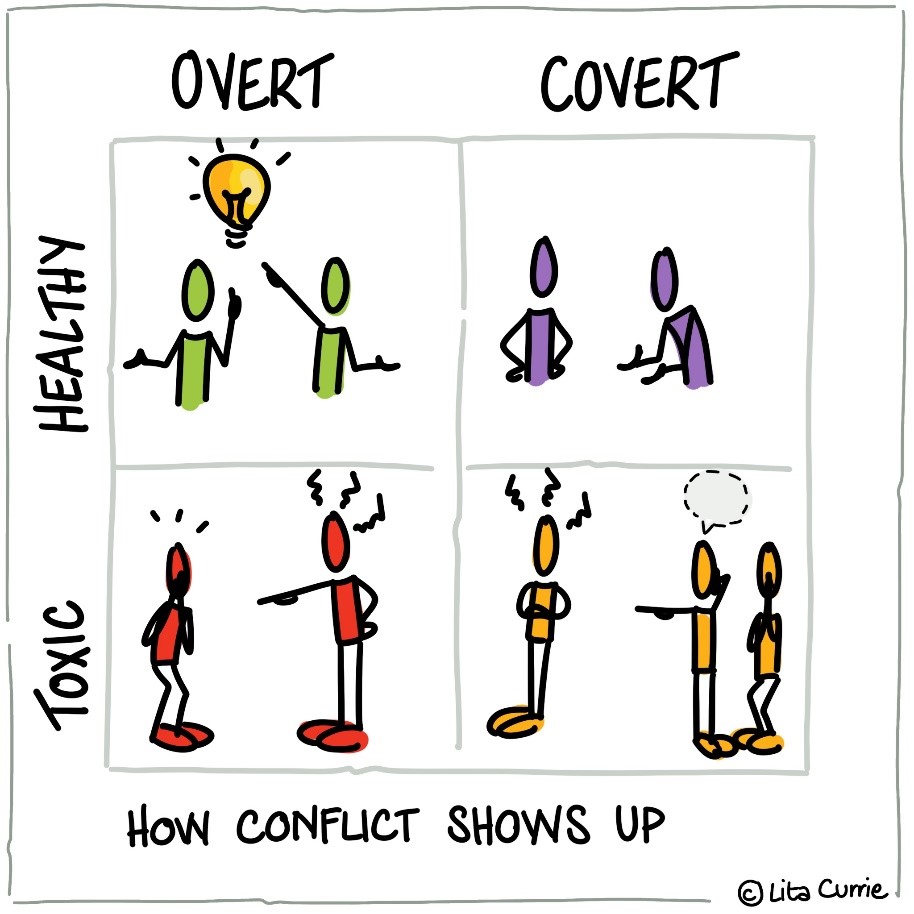
Toxic covert conflict leads to ignoring of the problem, backbiting and sabotage.

Toxic overt conflict means shouting, swearing and storming out.

Covert healthy conflict, although better, does not really resolve anything because usually issues are talked around instead of talked through.

What you’d like in your team is healthy overt conflict, where people engage in constructive challenge, sharing of ideas, questioning of assumptions – this leads to a healthier team able to achieve more.

In Patrick Lencioni’s model of the 5 dysfunctions of a team, fear of conflict is the second layer of the pyramid, showing just how important it is. What can you do as a team leader to ensure that your team masters conflict?

  1. Acknowledge conflict as a force for good. Conflict could be a great tool to spur the team on to greater performance. As a team leader show through your words and actions that conflict should not be ignored. When there is conflict in a team – like disagreements and frustration – acknowledge the conflict and bring it out into the open. “It looks like there are differences of opinion here, which is great. Let’s explore that more.” This gives your team the permission to engage in overt conflict and stops the issue from going underground.
  2. Play the ball and not the man. A critical part of constructive challenge is to challenge the idea and not the person coming up with the idea. When facilitating conflict conversations with your team identify the idea as a separate thing, not related to the person who it belongs to. Allow team members to discuss the idea and it’s merits and make it easy for people to change their minds. What works well is to have the team choose which idea they like and debate it. Then, get everyone to move to another idea, preferably one that they don’t agree with, and allow time where they have to make the argument for that idea. This is a powerful way to move perceptions and really get to the best idea.
  3. Allow for clearing conversations. A lot of conflict tends to simmer just under the surface for a long time if it’s not allowed into the open. In a team I worked with one team member held a grudge for years against another member who failed to greet them one day. (I kid you not!) Create deliberate time for the team to have clearing conversations one-on-one with members by using a structure for the conversation.
  4. Agree ground rules. Involve the team in crafting “rules of engagement” for how they will behave when conflict arises. Examples could include “we keep our voices calm”, “we do not call people names”, “we request a 10 minute cool-down if things get heated”. Have these guidelines visible in the meeting room so that people can be reminded of them and encourage all members to hold themselves and others accountable.

Contact us to run a workshop for your team to master conflict and create it as a fundamental behaviour.

Previous Post

3 Superpowers that unite your people and make wonders

Next Post

Caitlin Watson Episode 2 identifying the types of imposters

Lita Currie

Lita Currie

Lita Currie has over 20 years’ experience in learning and development, with expertise in management and leadership. She has trained and consulted in Africa, the UK and north America and has been instrumental in designing and implementing global development programmes across a variety of disciplines, in particular Human Resources, Finance and Corporate Affairs. She is an expert in visual learning and performance management, using graphic facilitation to ensure that the learning is effective.

Related Posts

Leadership for the hybrid workplace
Culture and Engagement

Leadership for the hybrid workplace

March 13, 2023
Addressing working mothers needs in the world of work
Article

Addressing working mothers needs in the world of work

February 28, 2023
Diversity, Equity and Inclusion (DEI) and belonging require leaders who will move beyond awareness
Article

Diversity, Equity and Inclusion (DEI) and belonging require leaders who will move beyond awareness

February 28, 2023
Addressing the gender gap requires effort on both sides of the equation
Article

Addressing the gender gap requires effort on both sides of the equation

February 28, 2023
Why it’s important for more men to join the fight for gender parity
Article

Why it’s important for more men to join the fight for gender parity

February 28, 2023
Discussing disconnected syndrome Podcast
Culture and Engagement

Dare to see us interview with Rikky Minyuku

February 28, 2023
Next Post
Discussing disconnected syndrome Podcast

Caitlin Watson Episode 2 identifying the types of imposters

Topics

  • Culture and Engagement
  • Diversity
  • Employee Wellbeing
  • Events
  • Inspire
  • Learning and Performance
  • Reflection point
  • Sponsored Article
  • The Hybrid World of Work
  • Tools & Tips

Important Links

About Talenttalks

FAQ

Contact Us

Recent articles

Quick Menu

  • About
  • Culture and Engagement
  • Learning and Performance
  • The Hybrid World of Work
  • Employee Wellbeing
  • Podcasts
  • Events
  • FAQ

Newsletter Signup Form

Select list(s) to subscribe to


By submitting this form, you are consenting to receive marketing emails from: . You can revoke your consent to receive emails at any time by using the SafeUnsubscribe® link, found at the bottom of every email. Emails are serviced by Constant Contact

© Talenttalks Evolve Thinking  |   Privacy Policy   |   Terms and Conditions   |   HTML Sitemap

  • Culture & Engagement
  • Diversity
  • Hybrid World
  • Inspire
  • Learning & Performance
  • Magazine
  • Tools
  • Wellbeing

© Talenttalks Evolve Thinking  |   Privacy Policy   |   Terms and Conditions   |   HTML Sitemap

This website uses cookies. By continuing to use this website you are giving consent to cookies being used. Visit our Privacy and Cookie Policy.